 English
 ไทย
ไทย
The Mint
History
1. Phra Krasapnisitthikan Mint, Thailand's First Mint (1860 – 1875)
.jpg)
Thailand's first mint was established during the reign of His Majesty King Mongkut (Rama IV), an era when Thailand was developing and modernizing, alongside the expansion of its economy and trade. In 1858, King Rama IV graciously commanded its construction and bestowed upon it the name "Phra Krasapnisitthikan Mint." It was located in the bullet money factory area in front of the Royal Treasury, at the street corner near the eastern exit of the Suwan Bariban Gate. It was a two-story brick building in a Western architectural style, with a staircase to the second floor at the front. The first coins produced were officially issued on September 17, 1860, featuring the Great Crown emblem within a chakra, in 5 denominations: Baht, Half-Baht, Salueng, Fuang, and Half-Fuang. They were to be used alongside bullet money, but no further production of bullet money was permitted. In 1862, His Majesty commanded the additional production of tin coins in the denomination of Aths and Solots, and in 1866, copper Seik and Siao coins were produced to replace cowrie shells.
2. Phra Krasapnisitthikan Mint, King Rama V Period (1875-1902)
.jpg)
During that period, the Thai economy flourished alongside the expansion of foreign trade. The production of coins for circulation in the economy faced issues with insufficient supply to meet demand, compounded by the aging and damaged original machinery. Therefore, His Majesty King Chulalongkorn (Rama V) graciously commanded the purchase of new, higher-capacity steam-powered coin production machinery, and simultaneously ordered the construction of a new, larger Phra Krasapnisitthikan Mint to accommodate the increasing demand for coins. The Phra Krasapnisitthikan Mint, Thailand's second mint, was built on the western side of the Suwan Bariban Gate, opposite the original mint. It featured Western-style architecture, a two-story rectangular brick and stucco building (currently the Temple of the Emerald Buddha Museum). The inauguration ceremony and official opening of the mint took place on May 31, 1876. The new currency emblem featured a royal effigy and the state emblem in denominations of one Baht, one Salueng, and one Fuang. These were the first Thai coins to bear the effigy of the monarch on the obverse in a universally accepted style, a practice that continues to this day.
3. Phra Krasapnisitthikan Mint, Khlong Lot Bank (1902-1972)
.jpg)
The country's trade advancements led to an increased demand for coins, while the existing steam-powered machinery began to deteriorate after 25 years of continuous use. Therefore, His Majesty King Chulalongkorn graciously commanded the construction of a new Phra Krasapnisitthikan Mint in the area that was once the residence of six royal princes, known as "Wang Saphan Siao," on the Khlong Lot bank, along Chao Fa Road, north of Sanam Luang. It was a two-story brick and stucco building in a western architectural style. After the mint relocated to its new site, the Fine Arts Department registered it as a national ancient monument, which is currently the "National Gallery on Chao Fa Road." The official opening ceremony of the third mint took place on February 4, 1902, and it was elevated to the status of the "Phra Krasapnisitthikan Department." New electricity-powered coin production machinery was installed, capable of producing approximately 80,000 to 100,000 coins per day without overtime work. Bullet money was commanded to be abolished by July 31, 1908.
Upon the enactment of the "Gold Standard Act, Rattanakosin Sok 127 (1908)," His Majesty graciously commanded the production of 1,036,691 one-Baht coins featuring the royal effigy and the erawan elephant emblem from the Paris Mint. However, they were not issued before the end of his reign. The erawan elephant emblem was used as the national emblem until the end of King Vajiravudh's reign. During the reign of His Majesty King Vajiravudh (Rama VI), Thailand was affected economically by World War I. The price of metals used in coin production rose, necessitating a reduction in the silver content and the issuance of one-Baht banknotes to replace coins.
His Majesty King Vajiravudh implemented various policies to balance the country's economic situation with the global economy and prevent potential impacts. However, these efforts could not entirely avert the widespread and severe global economic downturn, which persisted until the end of his reign and continued into the reign of His Majesty King Prajadhipok. During the reign of His Majesty King Prajadhipok (Rama VII), he addressed the country's economic situation, and concerning currency production, he graciously commanded the reclassification of the Phra Krasapnisitthikan Department as a factory under the Royal Opium Department. The coins used during this reign were 5-Satang nickel and 1-Satang copper coins imported from abroad to save on production costs, and domestic coin production had to cease for a long period of 6 years. The 50-Satang and 25-Satang silver coins, featuring a royal effigy of an elephant standing on a pedestal, were the official coins of the reign. In 1933, he graciously commanded the re-establishment of a mint to produce coins domestically; it was founded as the "Mint Division" and transferred to the Ministry of the Royal Treasury. Subsequently, it was elevated to the status of "Mint Bureau" under the Treasury Department, Ministry of Finance. His Majesty King Ananda Mahidol ascended the throne as the eighth monarch of the Chakri Dynasty. During that period, Thailand faced another economic downturn with the outbreak of World War II in 1939. The government addressed the shortage of small change, caused by rising commodity prices, by melting down two- Salueng silver coins from its treasury to produce 20-Satang, 10-Satang, and 5-Satang silver coins for use instead of importing them. This marked the first time silver was used to produce small change. As the prices of silver and copper increased, tin was used as a substitute. The official coin of this reign was the tin coin featuring the garuda emblem.
4. Pradipat Mint (1972-2001)
.jpg)
The fourth mint was situated on an area of approximately 11 rai, with ample space for installing several modern machines. It was completed and commenced operations on August 25, 1972; it was capable of producing approximately 2 million coins per day or 750 million coins per year. The reverse designs of the coins were changed several times to convey clearer and more systematic meanings while retaining the symbols of nation, religion, and monarchy. The obverse of all denominations featured the effigy of King Rama IX, representing the institution of the monarchy, along with the inscription "Thailand," representing the institution of the nation, and important religious ancient sites unique to the nation, representing the institution of religion. These newly designed coins have been produced annually for circulation until the present, with the Buddhist era year on the coin changing according to the production year.
A major change in coin design occurred in 1986 when the government adopted a policy to produce a new series of coins for all denominations, by improving their size and design, as well as by introducing, for the first time, circulating coins in denominations from 1 Satang to 10 Baht. Currently, circulating coins are produced in the following denominations: 10 Baht, 5 Baht, 1 Baht, 50 Satang, 25 Satang, 10 Satang, 5 Satang, and 1 Satang. During this reign, "commemorative coins" were produced for the first time in 1961 to commemorate and record important events, akin to inscribing history onto coins. This was on the occasion of Their Majesties the King and Queen's return to Bangkok after their royal visits to the United States, England, and European countries, which brought renown and honor to Thailand. Polished commemorative coins were first produced in 1982, marking another advancement for the Thai mint. In addition to producing commemorative coins to honor Their Majesties the King and Queen and other members of the royal family, coins were also produced as part of cooperation projects between the government and international organizations, such as the commemorative coins for the International Year of the Child in 1982 and the commemorative coins for Nature and Wildlife Conservation in 1997.
5. Rangsit Mint (2002 – Present)
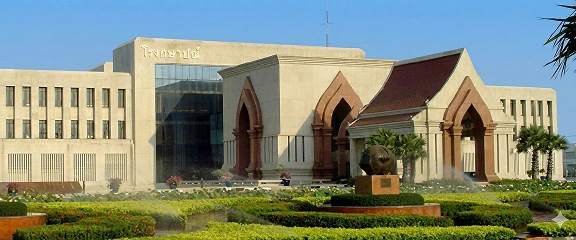
The rapid development of technology and economic growth led to global trade and increased fluidity in currency circulation, which, in turn, increased the demand for coins in the national economy. Therefore, it became necessary to increase production capacity to meet the demand for circulating coins in the economy. This involved upgrading the mint by installing more modern machinery, with the goal of being able to produce approximately 1,000 million coins per year. However, due to the Pradipat Road Mint's location in a residential area, its limited space prevented factory expansion, and pollution from the production process affected the surrounding community.
The government adopted a policy to relocate the mint to a spacious area outside the city, away from residential communities. Thus, a resolution was approved in 1987 to construct a new mint. This new construction site is located in the area of the Ministry of Finance's former jute bag factory, Phahonyothin Road, Kilometer 34-35, Khlong Nueng Sub-district, Khlong Luang District, Pathum Thani Province, on an area of approximately 126 rai.
The relocation of the mint to a spacious area outside the city aims to prevent and reduce toxic pollution issues from the production process and to accommodate future expansion of production capacity. Additionally, modern and highly efficient machinery and equipment were installed to ensure sufficient coin production to meet the current demand and to support the country's economic growth in the future.